
In the late nineteenth and early twentieth centuries, Italian families came to Windsor in search of employment. These newcomers established tight-knit communities, family businesses, and shared traditions to survive economic uncertainty and discrimination.
Begin Exploring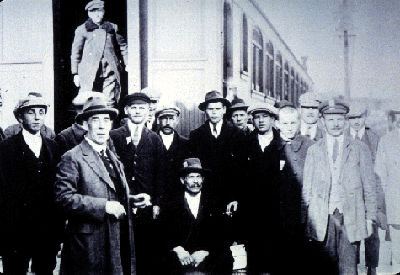
Italian immigrants en route to Ontario in the early 20th century. Many Italian men came to Canada through American ports and looked for jobs in railway construction. Retrieved from The Canadian Encyclopedia and United Church Archives.
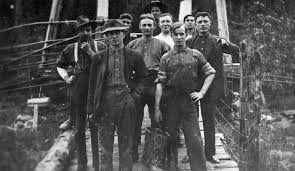
A group of workers, Canadian, American, Swedish, Italian and Scots in a C.N.R. construction camp in Agabob, B.C. (1913). Retrieved from Library and Archives Canada / MIKAN 3194431.
Italian immigrants arrived in Canada and the United States in two waves during the twentieth century, primarily driven by economic opportunities. The first wave was between the early 1900s and World War I. The second wave was primarily after World War II.
In the first wave of Italian migration to Canada, Italian migrants immigrated in search of employment opportunities. Immigrants were drawn by opportunities to build transcontinental railroads, work in grain elevators, work in mines, and work as tradesmen. Immigrants worked in harsh and dangerous conditions while also facing discrimination.
Many of the 60,000 Italian immigrants settled in Ontario. Since positions were often seasonal and harsh, many immigrants who were unable to find suitable work returned to Italy. However, some immigrants found jobs elsewhere and began to establish roots in Canadian cities. Many workers looking to feed their families moved to cities like Windsor. Windsor was ideal due to its proximity to Detroit, and as the city's automotive and construction industries grew, so did the Italian population.
Although many worked in factories or construction, some began businesses.6 As many Italians moved back to Italy, some stayed in cities like Windsor in search of economic opportunities. A culture of hard work, dedication, and commitment to family flourished among Italian immigrants. This work culture among Italian immigrants in Windsor quickly became a pillar of business success.
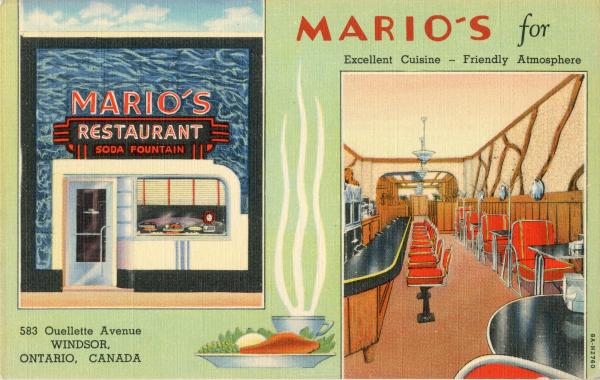
Mario's Restaurant, Windsor, Ontario, Canada (1935). Postcard from Mike Skreptak Collection. Retrieved from Leddy Library, University of Windsor.
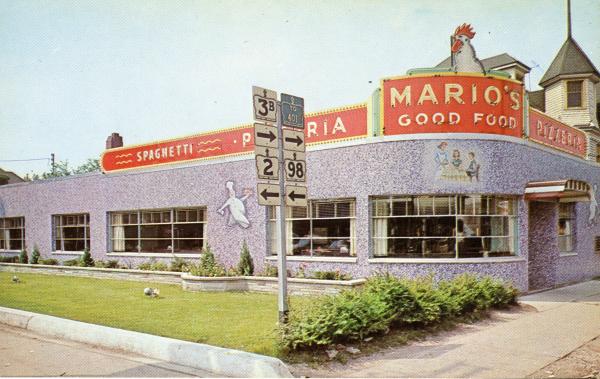
Mario's Restaurant, 2105 Ouellette Ave., Windsor, Ontario, Canada (1960). Postcard from Mike Skreptak Collection. Retrieved from University of Windsor, Leddy Library.
Mike Mario came to Canada in 1910 and got his first job at 15-years-old, working on the construction of the Canadian Pacific Railway. Mario later moved to Montreal and developed a love for cooking. Mario later moved to Montreal and developed a love for cooking.
Mario then moved to Windsor in 1923 and later opened his restaurant in 1928, which served a variety of foods, including pizza. In 1930, the restaurant moved locations from the British American Hotel to 493 Ouellette Ave. At the height of its popularity, there were 3 restaurants operating within the city. Although their roast beef was popular, the business was also known for its pizza. At one point, the owners shipped 40 of their pizzas to a couple in Texas.
The diner was known to attract entertainers from the Elmwood Hotel (a famous Windsor entertainment venue and hotel on Dougall Avenue), such as Cher.7 Mario's story shows the early growth of an Italian-run business. These businesses worked to create family environments through their diner-style format and customer relationships. Mario, who came from gruelling railway work, developed a love for cooking and put in countless hours running his business. Mario's restaurant highlights the early success of an Italian-run business in Windsor that served pizza and gained notoriety.
In the United States, many Italians also migrated in search of new economic opportunities. Unlike Windsor, Italians in Detroit did not have long-lasting areas of Italian culture. As the twentieth century approached, many Italians migrated to Michigan due to the economic hardship following Italy's unification. Due to labour demand in Michigan cities and mining towns, this area was the ideal destination.
Compared to Windsor, Detroit attracted many Italian immigrants due to the booming manufacturing and service industry in the early twentieth century. Italians in Detroit also established hubs by opening shops, restaurants, and pizzerias along Gratiot Avenue, creating a "Little Italy."
As Italians in Detroit gained more economic freedom and Detroit’s residential landscape changed amid patterns of racial segregation, Italian communities moved out of their neighbourhoods. In contrast, Italians in Windsor created a unique centre of Italian culture on Erie Street.8 Although Detroit experienced significant migration during the early 1900s, changing social landscapes encouraged Italians in Detroit to move beyond the downtown core, diminishing a distinct space for Italians in Detroit.
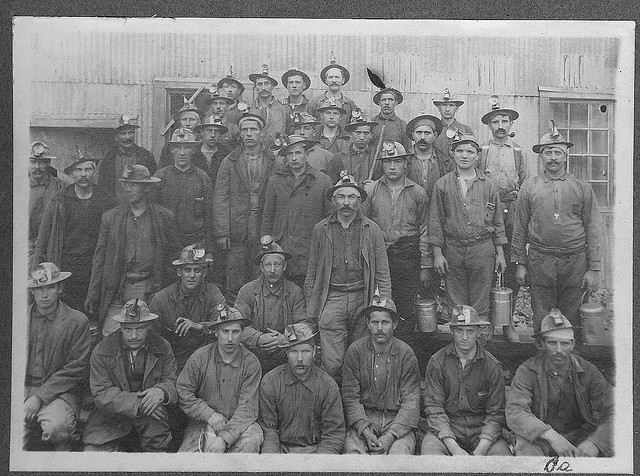
Copper Miners in Calumet, Michigan, between 1907 and 1920. Retrieved from "The 'Little Italies' of Michigan".
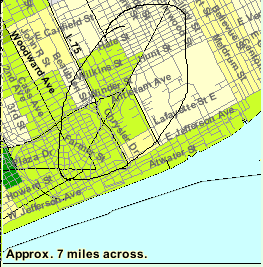
Map of "Little Italy" in Detroit. Retrieved from "The 'Little Italies' of Michigan".
It was not until the second wave of Italian immigration following World War II that much of Windsor's Italian identity was formed. However, these early immigrant communities in Windsor during the first wave of Italian immigration laid the foundations for Italian communities to develop their identity in a distinct space. Therefore, early migration to Windsor and the availability of job opportunities laid the foundation for Italian businesses. This foundation encouraged the expression and integration of Italian culture in Windsor pizzerias, making it part of Windsor's identity.
Use this lesson about early Italian immigration in your classroom. The provided lesson is best suited for Grade 10 History and Grade 11 Food and Culture.
Download Lesson Plan PDF Download Webquest Worksheet PDF Download Early Italian Immigration to Canada Slides